
BY Barbara BAudissard
Organisations today need to establish a new language, particularly in the world of HR (Human Resources). To move from a logic of control and evaluation to one of GIVING: creating spaces in which groups of professionals feel inspired to perform. HR has a central role to play in driving change, yet it is currently constrained by the bureaucratisation of its activities, which has distanced it from its true mission.
We carried out an experiment.
During my journey through Polynesia, I had the opportunity to study the indigenous peoples of those regions with the curiosity of an anthropologist at heart. In the Melanesian system[1], in particular, becoming a person of standing requires one to “have”, certainly, as it does everywhere. Yet prestige lies in giving: giving generously and giving everywhere. Giving matters, but why? To build relationships. What if the gift were precisely the means through which human beings create their societies? What opens the way to giving is the human desire to establish social relationships, because human beings are not content simply to live in society and reproduce it, as other social animals do: they must create society in order to live.
These reflections became the starting point for our experiment. Two days of camping with two distinct groups of professionals who needed to explore the concept of integration. A delicate theme that needs to be welcomed and grounded in a Safe Field[2]. There was not enough time for the participants themselves to create it: hence the idea of entrusting this task to a group of HR professionals alongside a number of managers.
An idea already adopted in other experiences, but one that takes on particular symbolic significance here, as part of a fundamental rethinking of the role of HR: HR as a creator of safe spaces. As a champion of the idea that only within safe fields can people perform and give their best, allowing their talents to emerge.
A few calls to envision and design the camp, followed by a full day to bring it to life. The challenge: to attend to the details too, to make people feel welcome, to let them feel that someone had taken care of them.
An intense day devoted to others, without expecting anything in return: a gift that flows in one direction and seeks no explicit recognition. A group of people who, through their culture and sensitivity, take care of another group of people.
Yet what is extraordinary is that these people then return home and are not present when the participants arrive: an even more powerful symbolic gesture. In a society where the pursuit of the spotlight sets the rules of the game, and individualism leads us to believe that professional success depends solely on our own efforts, here we encounter an act of giving free from any expectation of visibility in return.
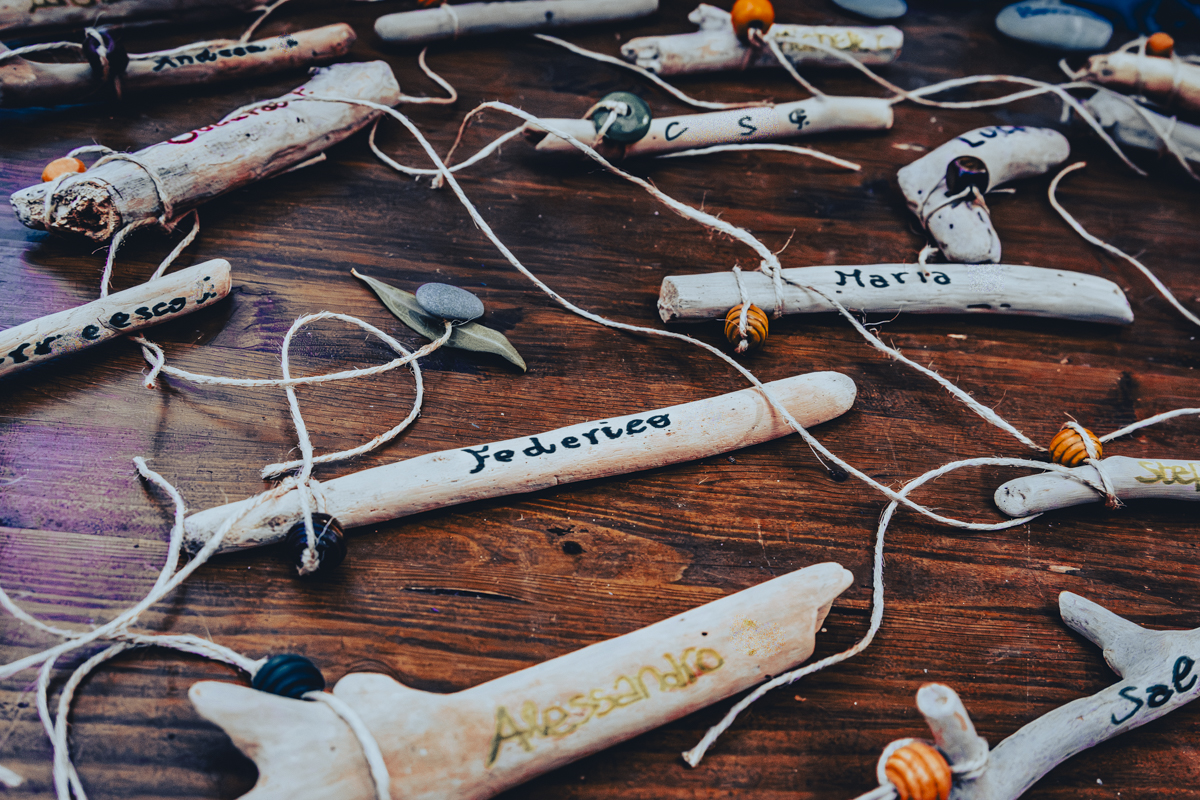
Because a safe space is made up of many elements: people do not perceive it as safe simply because the relevant regulations have been addressed, but because someone has considered what would create a sense of safety for the participants. From this comes the initial embrace of welcome, with names handwritten on pieces of wood gathered during seaside holidays and donated to the project. Pieces of wood used as imaginary keys to tents arranged according to a design centred on welcome and comfort.
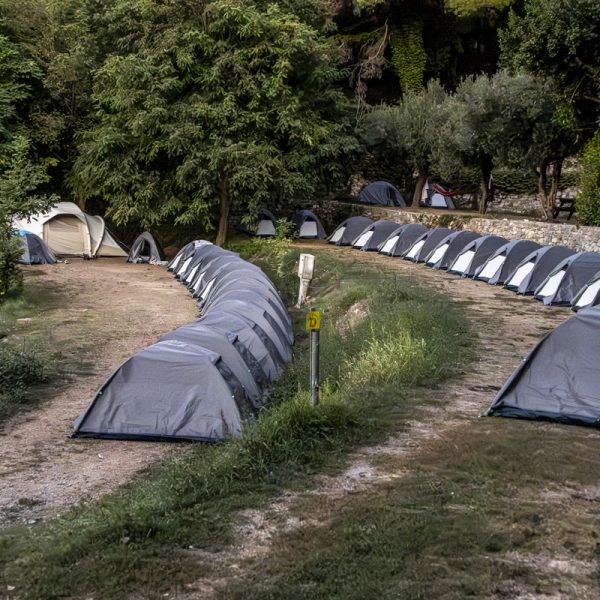
A shared box of useful items that someone might have forgotten to bring. A village that carries within it the idea of the Agora, a space in which things can happen, enhanced by lights and tables brought together. Around forty tents positioned so that everyone could enjoy their own privacy, while remaining close to the main tents of the observers and facilitators, set up as points of reference, both visual and emotional.
Eight hours of continuous work, during which fatigue gave way to care and to the awareness that something special was being created.
The photographs, a record that makes the day unforgettable, capture calm, focused faces. And the smiles during moments of rest reveal how giving is, first and foremost, an act that brings wellbeing to the giver.
[1] Marcel Mauss, “Saggio sul dono. Forma e motivo dello scambio nelle società arcaiche”. Piccola Biblioteca Einaudi, 2002
[2] Niki Elliott, “Heart Centered Connections”. 2026

And so… let us imagine an organisational world in which HR takes on this role: the role of giving. And approaches recruitment, evaluation and development in this spirit. A role that becomes a source of gifts. The explicit and implicit objectives of the role change; so too does the ergonomics of the spaces it occupies. Those spaces extend throughout the organisation, alongside the business; desks move, becoming embedded in organisational life. Because giving requires an understanding of what should be given, and to whom. An essential step in the process of giving is to offer what the other person needs, rather than to give simply for the pleasure of doing so. How can I know what another person needs unless I become part of the operational fabric of the organisation?
A first experiment.
A first moment of giving.
A new language: giving.
A small step. A necessary one.
Barbara


